Новости:

Форум Infotex WeaponMod

Просмотр сообщений

В этом разделе можно просмотреть все сообщения, сделанные этим пользователем.


Сообщения - va3bpf

Страницы: [1]
1
Version 0.2.0 fixes the S-meter and Color Code (CC) issues, adds AM/SSB demodulation modes, and includes several other bug fixes and improvements.

2
Stock firmware everything was okay.

I am more concerned right now, that it doesn't receive anything on DMR on any DMR channel, in channel mode or VFO mode.  It worked on the stock firmware. 

I have other radios that can receive the DMR transmissions with no issue, but this firmware, there is no audio and no S-meter movement.  I can understand that one channel might have incorrect settings, but not on every DMR channel.  I have entered the information in VFO mode with the color code, slot, etc., and nothing.

Maybe there is a way to completely wipe the firmware and start over again?  Also, I find that I can use OpenGD77 cps to flash the .bin file with its built-in flash utility.

First, make sure FM mode is working properly. Then, tune to the DMR frequency, switch to FM mode, and set the squelch to 0. Check whether you can hear the digital signal in FM mode.

If you hear nothing, it likely means there is no signal on that frequency. If you can hear the digital signal, switch back to DMR mode and see whether the radio can decode it.

If you have another DMR radio available, it would be much easier to troubleshoot and identify the root cause of the issue.

3
See attachment.

Hi,

Thanks for sending the flash dump. I loaded your codeplug and settings onto my own DM-32, keeping my own calibration for now. On both VFOs, FM and DMR, my radio receives and transmits normally with your data. So the codeplug and settings don't seem to be the cause.

A couple of things are worth checking on your side:

RX Only: some of your channels are set to RX Only, and PTT is refused on them.
VFO split: one of your VFOs has different RX and TX frequencies. It transmits on the TX frequency, so a radio listening on the RX frequency won't hear it.
Could you let me know:

Which channel or VFO you're on when it doesn't transmit.
What the screen shows when you press PTT: a message, the TX screen, or nothing.
Whether another radio nearby hears anything.
Whether it transmitted fine on the stock firmware.
I'm now testing with your calibration data as well, and will post the result.

73, VA3BPF

4
When I press the PTT on a DMR channel, the top LED flashed red rapidly.  No error messages.

The LED should stay solid red while transmitting. If your 16 MB flash doesn't contain any sensitive information, could you share a backup with me? I think we may only need the first 2 MB to start troubleshooting. You can compress the backup into a ZIP file, which should make it fairly small.

5
When I upgraded to this firmware, my existing codeplug remained untouched. 

All the DMR settings were correct, they worked with the previous firmware. 

I did make a new test codeplug, and the same result.  Green light comes on during a transmission, but no audio.  FM analog seems to work fine.

Is there a "promiscuous" mode?

Maybe some corrupted codeplug data is causing the firmware to behave abnormally.

When you press the PTT button, does the screen switch to the TX interface or display any error message? The LED should turn red during transmission.

6
Observations:

DMR doesn't work.  No RX or TX.

No way to select AM mode for VHF aircraft band receive.

Make sure the frequency, Color Code (CC), and Time Slot (TS) match on both sides. DMR should then work as expected.

BTW, I've added AM and SSB (USB/LSB) support to the latest code, but I haven't released a firmware build yet. You can build it yourself from the source code.

7
Hello,

I currently don't have the stock DM-32 firmware on my radio.  I have the Koshak version custom firmware. 

So, how might this affect the upgrade procedure?  I did do the calibration backups when I went from the stock DM-32 firmware to the Koshak version.  Do I still need to do the calibration backup first?  Any other things to lookout for?

Hello,

Coming from Koshak's firmware is fine. OpenDM32 keeps all its data above 7 MB in the data flash and never touches the factory calibration below that. Even the "Save" in its calibration menu only writes its own copy. OpenDMR reads the original factory table directly, so your radio's own calibration is used.

Keep your stock backups. They are your only way back to the stock firmware.
Still make a fresh backup of both chips before flashing (installation guide, section 2). It also gives you a way back to OpenDM32.
The install itself is the same as from stock: dm32_dump.py for the first install, then write your codeplug again with the OpenGD77 CPS.
73, BG8AM / VA3BPF

8
Hello everyone, and first of all many thanks to Koshak (RA4FHE, Alexey) for OpenDM32, for all the hardware work in this thread, and for making the source free to share and modify.

I'm BG8AM / VA3BPF. Building on OpenDM32, I've written OpenDMR, an open firmware for the Baofeng DM-32 / DM-32UV, and released the first version, 0.1.0. This thread is where the DM-32 firmware work started, so I'd like to introduce it here.

What it is
  • Rewritten on FreeRTOS. The features and the hardware knowledge come from OpenDM32 (and OpenGD77 before it).
  • A new user interface at the native 240x320 resolution, in English and Chinese.
  • DMR uses our own AMBE+2 compatible vocoder, so the firmware contains no stock firmware code at all. It works with other DMR radios, repeaters and hotspots.
  • Analog receive audio goes from the FD6818 straight to the speaker, as in the stock firmware, not through the HR_C7000 codec. So the CPU, flash, display and GPS activity is not heard in the speaker.

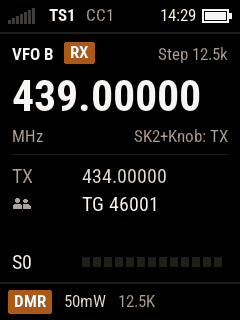
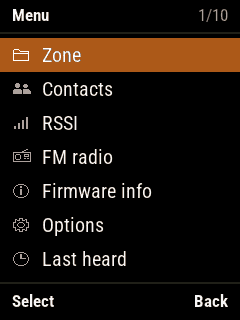
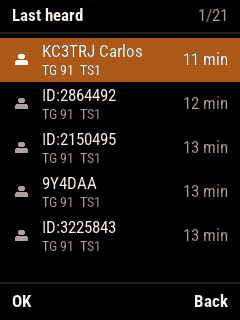
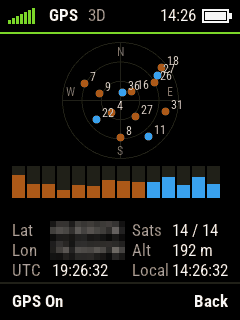
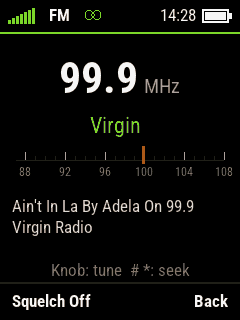
Screenshots (taken from the radio's frame buffer)
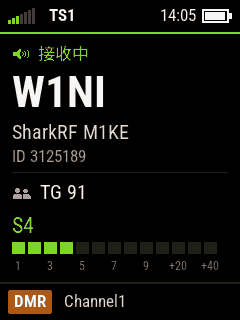

The first one is DMR receive (in the Chinese UI): the caller's callsign, name, DMR ID, talkgroup and S-meter.

Features
  • DMR / FM, channels and VFO A / B, direct frequency entry
  • Scan, dual watch (any two channels or VFOs)
  • Contacts, TG / private call entry, last heard, caller names from the DMR ID database written by the CPS
  • FM broadcast radio with RDS
  • GPS (GPS + BeiDou sky plot), APRS beacons, amateur satellite passes with Doppler correction
  • DMR hotspot (MMDVM / BlueDV over the programming cable)
  • VOX, 1750 Hz, DTMF, MDC1200, tail elimination
  • User-defined keys, SK2 + digit quick keys
  • Codeplug with the OpenGD77 CPS (Radio type DM32/UV008)

The vocoder
The AMBE+2 half-rate (3600x2450) encoder and decoder are our own implementation. There are three versions: Python, C in doubles, and fixed-point C for the CK803S (no FPU), which takes about 2.4 ms per frame to decode and 13 ms to encode. It was checked against the DVSI test vectors and md380-emu, and on the air with commercial radios. It is in its own repository, dmr-vocoder.

Tools
  • dm32_dump.py: backs up and writes the flash through the HR_C7000's bootloader (the same power-on handshake as OpenUV008_Flash and Roger VK3KYY's scripts). It runs at 250000 baud in 4 KB blocks, each with a CRC, and shows the progress on the radio's screen. About 2.5 times faster.
  • fw_update.py: once OpenDMR runs, updates it over the cable without the upgrade mode. It writes only the changed sectors (about 35 s), then the radio restarts by itself.
Installing
Flashing can brick the radio; you do it at your own risk. Back up both flash chips first: the data flash holds the radio's own calibration, which can't be recovered from another radio.
  • Download OpenDMR-0.1.0.zip from the release page and unzip it. You need Python 3 with pyserial on the PC; the stock CH340 cable works.
  • Backup: with the radio off, run dm32_dump.py, then switch the radio on within 30 s. Read each chip twice and compare.
  • Write the firmware and the Chinese font the same way (dm32_dump.py --write).
  • Write the codeplug with the OpenGD77 CPS.
  • For later updates, run fw_update.py with the radio on.
The installation guide has every step. Writing the backup back restores the stock firmware completely.

Links
Current limits
  • No voice prompts; the calibration is read only; no themes.
  • Not fully tested on the air yet: APRS decoding, the hotspot's CW ID, satellite passes, talkaround, distance sort.
  • No Russian UI yet. All UI strings are in one table (src/ui/text/), and the fonts would need Cyrillic glyphs (tools/fonts/mkfont.py). Help with a translation is very welcome.
  • Non-commercial use only, as with OpenGD77.

Feedback welcome
Issues and suggestions are welcome on GitHub or here. The most useful reports are: whether backup and flashing work on your batch of radios (which flash chips), how the DMR voice sounds, and how it works with your repeaters.

Thanks again to Koshak / RA4FHE, to Roger Clark VK3KYY, Kai Ludwig DG4KLU and the OpenGD77 authors, and to andynvkz for OpenUV008 and the flash tools.

73! BG8AM / VA3BPF

Страницы: [1]